
France’s debt trajectory is deteriorating, but capital flows remain resilient
France's situation is not yet a repeat of 2010-12. While yields on French government bonds (OATs) have climbed above their 2011-12 highs, the spread to Bunds remains below the peak from the Eurozone Crisis. And France today is different in that non-resident inflows to OATs has been strong so far this year, this matters for how this plays out.
Yet at current OAT yields, French public debt is "unsustainable" without a credible fiscal adjustment of 4% of GDP or more.
But conditions appear orderly. As noted, foreign investors are still buying OATs (data through July), the TARGET2 position is stable (data through August), and French banks retain ample liquidity. The key risk is that foreign inflows stop or reverse while ECB support remains uncertain.
The problem is the curve
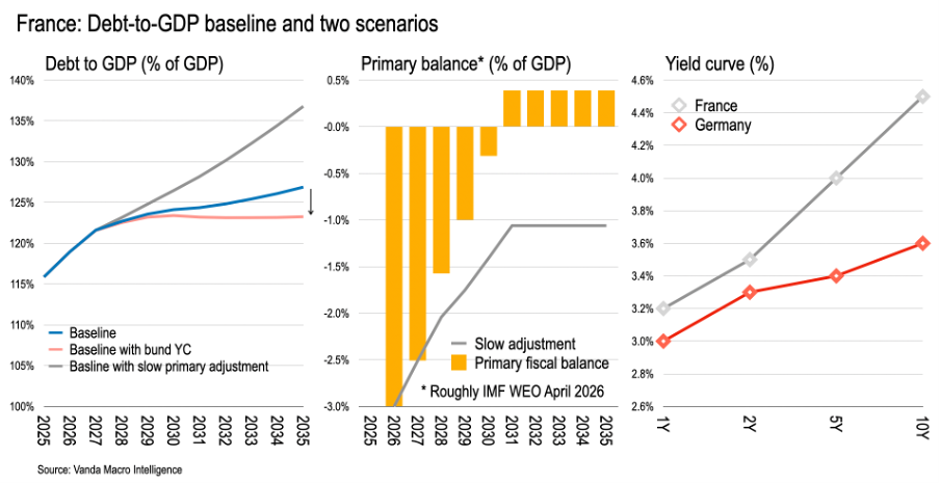
French public debt stands at about 115% of GDP, comprised primarily of roughly €3tn of securities. In addition, the primary fiscal deficit in 2026 will likely end up around EUR3% of GDP, with the budget for 2027 budget aiming to cut to around EUR2.5% of GDP.
At current OAT yields, France's debt path continues to deteriorate despite ambitious (assumed and not yet politically endorsed) fiscal tightening. Even with roughly 3.5ppts of GDP of primary balance adjustment by 2031, debt-to-GDP climbs past 125% and is still rising. In a slower scenario, where France delivers only half the adjustment for each future year, debt to GDP exceeds above 135% in 2035. Yet if France could borrow at the Bund curve, a 3.5ppts adjustment would stabilise debt from 2030.
The usual caveat is the "i - g" test. Legacy debt carries low coupons, but around 65% of coupon debt matures by 2035. Refinancing at current yields pushes the effective interest rate above the roughly 3% nominal growth the IMF expects, and it stays above even using Bund yields. Stabilising debt requires either nominal growth of 4% or more, or deeper primary balance adjustment, which will be politically hard to deliver with elections ahead.
The scale of the adjustment
France's required adjustment of 3.5-4% of GDP is not unprecedented: Greece, Ireland, Spain and Portugal delivered adjustments of 5ppts or more between 2009 and 2013.
However, this would exceed the eurozone-wide adjustment over that period and be around 1ppt of GDP larger than France's own adjustment in at that time. Today, that would be unusual for an economy the size of France, and unprecedented for it’s political establishment.
France and ECB support
The ECB's Transmission Protection Instrument is the presumed backstop, but whether France would qualify is an open question. It is difficult to argue fiscal policy is sustainable based on France’s current policies, unless the government commits to substantially more adjustment. Assuming adjustment with no political backing is a dangerous path for European institutions, especially the ECB.
Timing matters too. The more yields rise before TPI steps in, the more adjustment France would need. In one scenario, with higher Bund yields and a wider French spread, total tightening approaches 5% of GDP, beginning to resemble Spain's 2009–13 experience, albeit over a longer period.
No evidence of capital flight
Still, the latest data (through the summer) suggest this is different to the peripheral crisis. There is no sign of capital flight.
Non-resident inflows into OATs hit a record in the 12 months to July, whereas the periphery saw outflows in 2010-11. France's TARGET2 position has also stabilised, with the latest Banque de France data pointing to inflows over the past year.
It is as if higher OAT yields have attracted foreign investors, rather than yields being driven higher by foreign selling. Whether that held through September’s further rise in yields is unclear.
Banque de France OAT holdings and the liquidity buffer
There are proposals in France to cancel the OATs held by the Banque de France, but this would conflict with EU Treaty rules. It would not remove the cost either: excess reserves created by past bond buying are still remunerated at the deposit rate. The consolidated deficit of the French government and the Banque de France may therefore exceed the fiscal deficit alone. And with their portfolio bought when yields were negative or barely positive, the Banque de France faces a near-term loss, partly offset by income on foreign exchange reserves and gold valuation gains.
Even so, French banks retain ample liquidity. If non-resident inflows stopped, domestic banks could absorb the Banque de France's OAT run-off through 2031 with liquidity still to spare. The catch is concentration: far more OAT risk would sit on French banks' balance sheets, and their willingness to hold it depends on price and on politics.
So where does that leave OATs?
French debt looks unsustainable at the current OAT yield curve without a credible political commitment to around 4% of GDP primary fiscal adjustment or higher. With elections ahead, and a new ECB Executive Board line-up to be decided in the coming months, it is hard to predict how this will be resolved.
But this is not the periphery crisis in 2010-12. For now, France has a debt-sustainability problem rather than a funding crisis. With elections making fiscal adjustment harder and the global backdrop less forgiving, any turn in non-resident flows could be a game changer for OATs.
In his latest note, Chris Marsh examines why France's debt path looks so vulnerable, how much the Banque de France liquidity buffer can absorb, and the conditions that could turn today's orderly repricing into something more disruptive.
To access the full analysis, contact sales@vanda.com